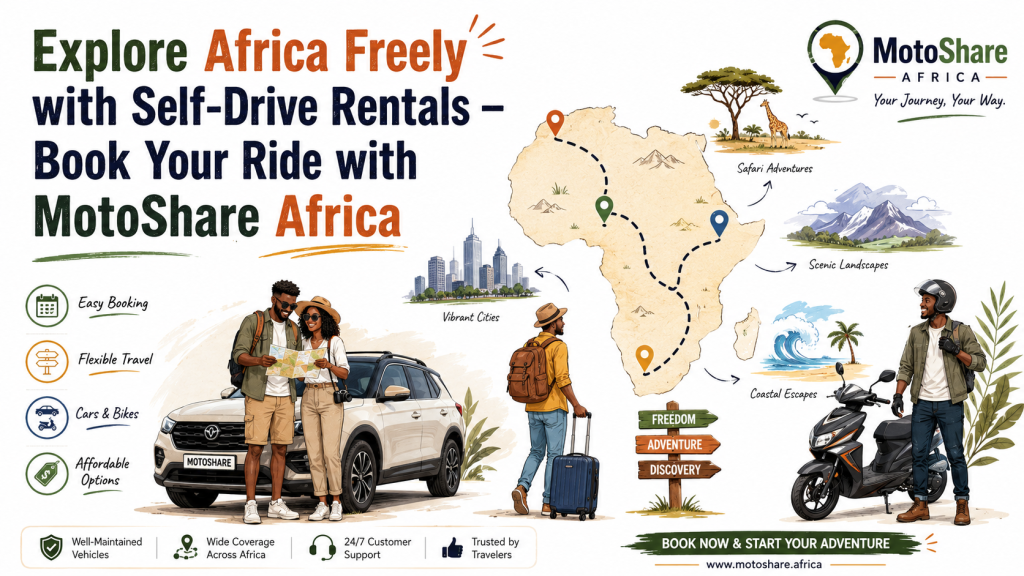
Introduction
Africa offers some of the most memorable road-trip experiences in the world. Travelers can drive along dramatic coastlines, explore historic cities, visit wildlife reserves, cross open desert landscapes, discover mountain routes, and reach small communities that may not be easily accessible by public transportation.
A self-drive vehicle rental gives tourists the freedom to explore these destinations at their own pace. Instead of following a fixed group-tour schedule, travelers can decide when to start, where to stop, and how long to stay at each destination.
However, planning a self-drive journey in Africa requires careful preparation. Africa is a continent made up of many countries, and each country has its own driving laws, road conditions, rental policies, border rules, insurance requirements, and licensing procedures. A rental arrangement that works in South Africa may not apply in Kenya, Morocco, Namibia, Tanzania, Ghana, Rwanda, Mauritius, or Botswana.
This guide explains how tourists can select the right rental vehicle, prepare the necessary documents, understand costs, examine insurance, follow safety practices, and avoid common rental mistakes.
It is particularly useful for first-time international travelers, Indian tourists, students, working professionals, couples, families, backpackers, safari travelers, photographers, digital nomads, and budget-conscious explorers.
Why Renting a Vehicle in Africa Is a Smart Choice
Public transportation is available in many African cities, but it may not always connect remote tourist attractions, national parks, coastal villages, desert areas, mountain routes, or countryside destinations.
A self-drive vehicle can make such journeys more convenient.
Greater Travel Freedom
A rental vehicle allows you to create a personalized itinerary. You are not restricted by bus departure times, group-tour schedules, or limited transport routes.
You can stop at viewpoints, restaurants, markets, beaches, cultural attractions, or small towns whenever it is safe to do so.
Better Access to Remote Destinations
Many popular African experiences are located outside major cities. Wildlife reserves, remote lodges, desert camps, hiking areas, waterfalls, beaches, and rural communities may require private transportation.
A suitable car or 4×4 can provide better access than regular public transport.
Convenience for Families and Groups
Families and groups can carry luggage, food, photography equipment, camping supplies, and personal belongings more comfortably in a rental car.
When rental and fuel costs are divided among several people, self-driving can also become financially practical.
Flexible Trip Planning
Weather, road conditions, local events, or personal preferences may require you to change your itinerary. A rental vehicle gives you more flexibility to adjust your plan.
More Privacy
Self-drive travel provides greater privacy than shared buses, taxis, or group tours. This can be valuable for couples, families, business travelers, and tourists taking longer journeys.
Who Should Consider a Self-Drive Rental in Africa?
Self-drive rental can be suitable for many types of travelers.
First-Time Tourists
First-time visitors can use a rental vehicle to explore well-developed tourist routes, provided they are comfortable driving in unfamiliar conditions.
It is sensible to begin with established routes, paved roads, shorter daily distances, and daytime driving.
Indian Tourists
Indian travelers may find driving on the left familiar in countries such as South Africa, Kenya, Tanzania, Namibia, Botswana, Zambia, Zimbabwe, Mauritius, Uganda, and Mozambique.
However, road rules, signs, vehicle standards, rental contracts, and local driving behavior can still differ considerably. Travelers should never assume that familiarity with left-hand driving removes the need for preparation.
Backpackers and Budget Travelers
Backpackers traveling together can share the cost of the rental, fuel, tolls, parking, and accommodation. A compact car or small SUV may provide an affordable way to connect multiple destinations.
Couples and Families
Couples and families often value the privacy, luggage space, comfort, and scheduling flexibility provided by a rental car.
Safari Travelers
Self-drive safaris are available in selected destinations and parks. Travelers must follow park regulations, remain inside the vehicle where required, maintain safe distances from animals, and use only permitted roads.
Adventure Travelers
Travelers exploring deserts, mountains, gravel roads, remote camps, or cross-border routes may require a 4×4, additional spare tyres, recovery equipment, navigation support, water, fuel planning, and emergency communication.
Business Travelers and Digital Nomads
Professionals who need to attend meetings in different parts of a city or region may find a rental vehicle more efficient than repeatedly arranging taxis.
Main Types of Self-Drive Vehicles Available
Choosing the right vehicle is one of the most important decisions in an African road-trip plan.
Economy Cars
Economy cars are compact, fuel-efficient, and generally suitable for city travel and established paved routes.
They are useful for:
- Airport transfers
- Urban sightseeing
- Short business trips
- Coastal drives on paved roads
- Budget travel
- Couples carrying limited luggage
An economy car may not be appropriate for rough gravel roads, deep sand, flooded areas, remote tracks, or routes requiring high ground clearance.
Sedans
Sedans provide more passenger comfort and luggage space than very small economy cars. They can be suitable for long paved-road journeys between major towns and cities.
Before booking, check boot capacity, ground clearance, transmission type, tyre condition, and air-conditioning.
SUVs
An SUV can offer better ground clearance, seating comfort, luggage space, and road visibility. Some SUVs have four-wheel drive, while others do not.
Do not assume that every SUV is suitable for serious off-road travel. Confirm whether the vehicle is a true 4×4 and whether the rental agreement permits it to be used on gravel, sand, or unpaved roads.
4×4 Vehicles
A 4×4 may be required for desert routes, remote safari regions, difficult gravel roads, mountain tracks, camping journeys, and seasonal road conditions.
A 4×4 rental may include:
- Higher ground clearance
- Four-wheel-drive capability
- One or two spare tyres
- Recovery tools
- Roof tents
- Camping equipment
- Water containers
- Refrigerator or cooler
- Extra fuel storage
Driving a 4×4 safely requires knowledge. Travelers should request a complete vehicle demonstration before leaving the rental location.
Minivans and People Carriers
Minivans are useful for larger families and groups. They provide additional seating and luggage capacity, but they may consume more fuel and require more parking space.
Check whether the vehicle has enough luggage room when all seats are occupied.
Motorcycles
Motorcycle rental in Africa may be available in selected cities, coastal destinations, adventure routes, and tourism areas.
Motorcycles may be suitable for experienced riders who want a more direct and immersive travel experience. However, long distances, heat, rain, road surfaces, wildlife, limited visibility, traffic behavior, and luggage requirements can make motorcycle travel challenging.
Travelers who regularly use motorcycle rental in India should still assess African road conditions separately.
Scooters
Scooters can be convenient for short urban journeys, islands, beach destinations, and smaller tourism areas.
A scooter is normally more suitable for short distances than for highways, remote routes, gravel roads, or long intercity journeys.
Electric Vehicles
Electric vehicle availability is developing in selected African cities and tourism markets. Before renting one, verify:
- Charging-station availability
- Charging time
- Realistic driving range
- Compatibility of charging connectors
- Availability of chargers at accommodation
- Roadside support
- Additional fees
- Route conditions
Electric vehicles are most practical when the route has reliable charging infrastructure.
How to Choose the Right Vehicle for Your African Trip
Do not select a vehicle only because it has the lowest daily rental price. Consider the complete journey.
Review the Road Surface
Identify how much of your journey involves:
- Paved highways
- Urban roads
- Gravel roads
- Mountain roads
- Desert tracks
- Deep sand
- Mud
- Seasonal river crossings
- National park roads
Ask the rental provider whether the chosen vehicle is permitted and suitable for every planned route.
Consider the Number of Travelers
Choose a vehicle with enough seating and luggage capacity. A five-seat car may not be comfortable for five adults carrying large suitcases.
Calculate the Total Distance
Long-distance driving requires comfort, fuel efficiency, luggage space, reliable tyres, and manageable daily travel times.
Avoid creating an itinerary that requires excessive hours behind the wheel every day.
Check Ground Clearance
Ground clearance is important on gravel roads, damaged surfaces, unpaved tracks, speed bumps, and park roads.
Select the Right Transmission
Automatic cars can be easier for travelers who are unfamiliar with local conditions. Manual cars may be cheaper or more widely available in certain locations.
Book the transmission type you are comfortable driving.
Review Fuel Availability
Fuel stations may be widely available around cities but separated by long distances in remote regions. Ask the rental provider where reliable fuel stops are located.
Match the Vehicle to the Climate
Air-conditioning is important in hot regions. During wet seasons, road conditions may require better tyres, additional ground clearance, or four-wheel drive.
Documents Usually Required to Rent a Vehicle
Requirements differ by country and rental provider, but tourists are commonly asked for several documents.
Valid Driving Licence
Carry your original, valid driving licence. The licence must normally cover the category of vehicle you are renting.
A photograph, scanned copy, or mobile image may not be accepted as a replacement for the original document.
International Driving Permit
An International Driving Permit may be required depending on the destination, language of your licence, rental company, and local law.
Indian travelers should obtain an official IDP before departure when required. An IDP normally works as a translation or supporting document and does not replace the original Indian driving licence.
Carry both documents.
Passport
International tourists normally need to present a valid passport during the rental process.
Visa or Entry Documentation
A provider may request proof of lawful entry or valid travel status, depending on local requirements.
Payment Card
Many rental companies require a credit card in the primary driver’s name to secure the booking and block the security deposit.
Some local or peer-to-peer providers may accept other payment methods, but this should be confirmed before booking.
Address and Contact Details
You may need to provide your home address, local accommodation details, mobile number, email address, and emergency contact.
Minimum Age and Driving Experience
Minimum rental age varies. Some providers also require the driver to have held a licence for a minimum period.
Young-driver fees or vehicle-category restrictions may apply.
Additional Driver Documents
Every person who may drive the vehicle should be registered in the rental agreement and present the necessary documents. Allowing an unauthorized driver to use the vehicle can affect insurance coverage.
What to Check Before Accepting the Vehicle
Never leave the rental location without inspecting the vehicle properly.
Vehicle Exterior
Check for:
- Scratches
- Dents
- Cracked lights
- Windscreen damage
- Mirror damage
- Wheel damage
- Missing trim
- Roof damage
- Underbody damage where visible
Take time-stamped photographs and videos from every side.
Tyres and Spare Tyres
Inspect tyre tread, visible damage, pressure, and sidewalls. Confirm the number and condition of spare tyres, particularly when traveling on gravel roads.
Tools and Safety Equipment
Confirm that the vehicle includes the equipment required for the route, such as:
- Jack
- Wheel spanner
- Warning triangle
- Reflective vest
- First-aid kit
- Fire extinguisher
- Recovery tools
- Air compressor
- Tyre-pressure gauge
Fuel Policy
Understand whether the vehicle must be returned with a full tank, the same fuel level, or according to another arrangement.
Ask which fuel type the vehicle requires.
Insurance Coverage
Read what the insurance includes and excludes. Pay particular attention to:
- Collision damage
- Theft
- Third-party liability
- Windscreen damage
- Tyre damage
- Underbody damage
- Roof damage
- Water damage
- Sand damage
- Single-vehicle accidents
- Wildlife-related damage
- Gravel-road incidents
- Unauthorized roads
- Night driving
- Cross-border travel
Basic insurance does not necessarily mean that every form of damage is covered.
Excess or Deductible
The excess is the amount the renter may be responsible for after an insured incident.
Ask how much it is, when it applies, and whether it can be reduced through additional coverage.
Mileage Limits
Some rentals include unlimited mileage, while others set a daily or total kilometre limit. Additional distance may be charged separately.
Emergency Assistance
Save the rental provider’s roadside-assistance and emergency telephone numbers. Confirm whether assistance is available in remote areas and whether towing costs are covered.
Rental Agreement
Read the full contract before signing it. Ask for clarification about any unfamiliar term.
Safety Tips for Self-Drive Travel in Africa
Follow Local Traffic Rules
Speed limits, road signs, parking rules, toll procedures, alcohol limits, and right-of-way rules vary by country.
Research the rules for every country included in your itinerary.
Confirm Which Side of the Road Is Used
Several countries drive on the left, while others drive on the right. This can also affect the location of the steering wheel, roundabout direction, overtaking behavior, and turning habits.
Take extra care after collecting the vehicle and whenever crossing into a country with different rules.
Avoid Driving After Dark
Night driving can involve limited street lighting, animals on the road, pedestrians, cyclists, damaged road surfaces, unlit vehicles, and reduced access to assistance.
Plan to arrive at your destination well before sunset, especially outside major cities.
Wear Seat Belts and Helmets
Every vehicle occupant should use a seat belt. Motorcycle and scooter riders should wear an approved helmet and protective clothing.
Never accept a damaged or badly fitting helmet.
Avoid Overspeeding
Drive according to road, weather, visibility, traffic, and wildlife conditions rather than simply driving at the maximum posted speed.
Gravel roads require lower speeds and longer braking distances.
Maintain a Safe Fuel Level
Do not wait until the fuel warning light appears in a remote area. Refill when reliable fuel is available.
Carry Water and Basic Supplies
For longer journeys, carry drinking water, snacks, essential medication, sun protection, a charged phone, charging cables, cash, and emergency information.
Use Offline Navigation
Download offline maps before entering areas with limited mobile coverage. Compare navigation directions with local advice, road signs, park maps, and information from the rental provider.
The shortest digital route may not be the safest or most suitable road.
Keep Wildlife at a Safe Distance
Never approach or feed wild animals. Follow national park instructions and remain inside the vehicle where required.
Animals always have priority.
Respect Security Advice
Ask your accommodation provider or rental company about routes, parking locations, neighborhoods, border crossings, and areas that should be avoided.
Do not leave passports, cash, electronics, or luggage visible inside a parked vehicle.
Estimated Self-Drive Rental Costs in Africa
Rental prices vary significantly by country, season, destination, booking period, vehicle availability, insurance package, road permissions, and pickup location.
The following ranges are general planning estimates rather than guaranteed prices.
| Vehicle category | Approximate daily range | Typical use |
|---|---|---|
| Scooter | USD 15–40 | Islands, beach towns and short city trips |
| Motorcycle | USD 30–120 | Experienced riders and adventure routes |
| Economy car | USD 25–70 | Cities and paved tourist routes |
| Sedan | USD 35–90 | Intercity travel and family trips |
| Compact SUV | USD 50–130 | Mixed paved and light gravel routes |
| 4×4 vehicle | USD 90–250 or more | Safaris, deserts and remote travel |
| Equipped 4×4 camper | USD 130–350 or more | Camping and overland journeys |
| Minivan | USD 70–180 | Families and larger groups |
The advertised rate may not include the complete cost.
Budget for:
- Insurance upgrades
- Security-deposit authorization
- Fuel
- Toll charges
- Parking
- Airport fees
- One-way fees
- Young-driver fees
- Additional drivers
- Border permits
- Cleaning
- Camping equipment
- Child seats
- Navigation devices
- Additional mileage
- Late-return charges
Common Mistakes First-Time Travelers Should Avoid
Booking the Cheapest Vehicle Without Checking the Route
A low-cost compact car may become expensive if it is damaged on an unauthorized or unsuitable road.
Ignoring Insurance Exclusions
Travelers sometimes focus only on the daily rental rate. Insurance exclusions can have a much larger financial impact.
Planning Excessive Daily Distances
Driving times can be longer than expected because of road conditions, fuel stops, weather, animals, checkpoints, or construction.
Driving After Dark
A schedule that depends on night driving creates unnecessary risk.
Failing to Photograph Existing Damage
Without clear evidence, it may be difficult to prove that damage existed before the rental began.
Assuming Cross-Border Travel Is Automatically Allowed
Taking a rental vehicle into another country usually requires advance permission and additional documentation.
Allowing an Unregistered Driver to Drive
Insurance may not apply when the person driving is not named in the agreement.
Relying Only on Mobile Internet
Coverage may be weak or unavailable in remote areas. Download maps and important documents in advance.
Carrying Too Little Water or Fuel
Remote travel requires greater preparation than city driving.
Ignoring Local Advice
Rental staff, accommodation hosts, park officials, and local authorities may know about road closures or seasonal hazards that are not shown on navigation apps.
Self-Drive Rental vs Public Transport vs Taxi
| Factor | Self-drive rental | Public transport | Taxi or ride service |
| Cost | Good value for groups and multi-stop trips | Often cheapest for basic city routes | Can become expensive over long distances |
| Convenience | High when the correct vehicle is selected | Depends on schedules and route coverage | High for individual urban journeys |
| Flexibility | Very high | Low to moderate | Moderate to high |
| Comfort | Private space and luggage control | Varies considerably | Generally suitable for short trips |
| Route access | Can reach many remote areas | Often limited outside established routes | Usually concentrated around towns and cities |
| Responsibility | Driver manages safety, fuel, parking and navigation | Transport operator manages the journey | Driver manages the journey |
| Travel experience | Independent and immersive | More local but less flexible | Convenient but less independent |
| Best use cases | Road trips, safaris, families and regional exploration | Budget city travel and established intercity routes | Airport transfers, evenings and short urban trips |
Self-drive rental is most suitable when independence and route flexibility are priorities. Public transport is useful for budget-conscious travelers following common routes, while taxis are practical for short urban journeys.
Motorcycle and Bike Rental for Tourists
Bike rental can provide an affordable and flexible transportation option in selected African destinations. It may be useful for short city rides, island exploration, beach areas, rural day trips, and destinations where parking a car is difficult.
Travelers familiar with a bike rental in India, self-drive bike rental, motorcycle rental India, or two-wheeler rental India should not assume that the same rental rules apply in Africa.
Before renting a motorcycle or scooter, check:
- Licence category requirements
- International Driving Permit requirements
- Helmet standards
- Insurance coverage
- Road restrictions
- Engine capacity
- Passenger rules
- Security equipment
- Breakdown support
- Weather conditions
- Luggage capacity
- Fuel availability
Tourists should avoid learning to ride during an international holiday. Motorcycle rental is most appropriate for riders with relevant experience.
In some destinations, renting a scooter can be practical for local exploration. For long-distance or remote travel, a car, SUV, 4×4, guided transfer, or organized tour may be safer.
Cross-Border Self-Drive Travel
Cross-border road trips can connect multiple African countries, but they require advance planning.
Before booking, ask the rental provider:
- Which countries are permitted?
- Is written authorization required?
- Are cross-border fees charged?
- Does insurance remain valid?
- Are additional insurance certificates needed?
- Are temporary vehicle permits required?
- Can the vehicle be taken on a ferry?
- Is one-way return available?
- What documents must be shown at the border?
- Are there route or road restrictions?
Carry printed and digital copies of the rental agreement, authorization letter, insurance documents, vehicle papers, passport, visa, driving licence, IDP, emergency contacts, and booking information.
Never attempt an unapproved border crossing in a rental vehicle.
How MotoShare Africa Can Help Travelers
MotoShare Africa is designed to help travelers discover self-drive mobility options for urban trips, holidays, business travel, and regional exploration.
Easy Online Discovery
Travelers can search for suitable vehicles based on destination, rental period, vehicle category, and travel requirements.
Wide Range of Vehicle Options
Depending on local availability, users may explore economy cars, family vehicles, SUVs, motorcycles, scooters, and other self-drive options.
Transparent Rental Information
Clear rental details help travelers compare vehicle features, usage conditions, included services, and potential additional costs.
Verified Vehicle Listings
Verification processes can improve confidence by helping travelers connect with genuine vehicle owners and rental partners.
Flexible Rental Periods
Travelers may need a vehicle for a few hours, a day, a weekend, several weeks, or a longer road trip. Flexible options make it easier to match the booking to the itinerary.
Support for Different Travel Styles
MotoShare Africa can support transportation planning for solo tourists, couples, families, students, professionals, backpackers, groups, and long-stay travelers.
Convenient Trip Planning
Using one platform to compare vehicle options can reduce the time required to contact multiple rental providers separately.
Actual availability, documents, pricing, insurance, deposits, and permitted routes depend on the vehicle, rental provider, and destination.
Practical Checklist Before Booking
Use this checklist before confirming a self-drive vehicle rental:
- Confirm that your driving licence is valid at the destination
- Obtain an official International Driving Permit when required
- Check the minimum driver age
- Review the complete route
- Select a suitable vehicle category
- Confirm allowed road surfaces
- Request cross-border permission where applicable
- Read insurance inclusions and exclusions
- Check the security-deposit amount
- Understand the fuel policy
- Confirm mileage limits
- Register every additional driver
- Ask about roadside assistance
- Save emergency contacts
- Download offline maps
- Plan fuel stops
- Avoid night driving
- Photograph the vehicle during collection
- Keep copies of all documents
- Inspect the vehicle again during return
Frequently Asked Questions
1- Can tourists rent a self-drive vehicle in Africa?
Yes, tourists can rent self-drive vehicles in many African countries. The requirements depend on the country, rental provider, driver’s age, licence type, driving experience, payment method, and selected vehicle. Travelers should confirm the rules directly before booking.
2- Can Indian tourists drive a rental car in Africa?
Indian tourists may be able to drive in many African destinations using a valid Indian driving licence, sometimes supported by an International Driving Permit. Requirements vary, so travelers should verify the destination’s rules and the rental provider’s policy.
3- Is an International Driving Permit required?
An IDP may be required when the national licence is not accepted, is not printed in a recognized language, or when the provider requests one. Carrying an IDP is often a sensible precaution, but it must be accompanied by the original driving licence.
4- How much does it cost to rent a vehicle in Africa?
An economy car may start at approximately USD 25–70 per day, while SUVs and 4×4 vehicles can cost considerably more. Season, destination, insurance, mileage, border permissions, and vehicle availability affect the final amount.
5- Is a 4×4 necessary for an African road trip?
Not every road trip requires a 4×4. Economy cars and sedans may be adequate for established paved routes. A 4×4 may be needed for remote areas, difficult gravel roads, deserts, selected safari routes, sand, mud, or seasonal conditions.
6- Can I take a rental vehicle into another country?
Cross-border travel may be possible, but it normally requires written permission from the rental provider. Additional permits, fees, insurance, taxes, or vehicle documents may be required. Unapproved border travel may invalidate the agreement.
7- Is insurance included in the rental price?
Basic coverage may be included, but it may carry a high excess and important exclusions. Travelers should examine collision, theft, third-party, tyre, windscreen, underbody, roof, gravel-road, water, and single-vehicle coverage.
8- What happens if the vehicle breaks down?
Contact the rental provider’s roadside-assistance number and follow its instructions. Do not arrange major repairs without authorization unless an immediate emergency requires action. Keep receipts and written records of all communication.
9- Can I rent a motorcycle or scooter in Africa?
Motorcycle and scooter rentals are available in selected destinations. Riders must have the correct licence, suitable experience, insurance, protective equipment, and any required IDP. Availability and legal requirements vary by country.
10- Are helmets provided with motorcycle rentals?
Many providers offer helmets, but availability, condition, fit, and certification vary. Confirm helmet inclusion before booking and inspect it before riding. Experienced travelers may prefer to carry their own approved helmet.
11- Can I rent a vehicle without a security deposit?
Some providers may offer reduced-deposit or deposit-free arrangements, usually under specific conditions or with additional coverage. Many companies still require a card authorization or refundable deposit.
12- Is it safe to self-drive in Africa?
Self-driving can be safe when travelers choose appropriate destinations, use suitable vehicles, follow local laws, avoid night driving, plan fuel and accommodation, monitor road conditions, and follow official travel and rental guidance.
13- Can I use an Indian self-drive rental account in Africa?
Accounts and verification may not automatically transfer between countries or platforms. Travelers should create or verify the required MotoShare Africa profile and upload the documents requested for the specific destination.
14- Should I choose unlimited mileage?
Unlimited mileage can be valuable for long road trips. For short city journeys, a limited-mileage package may be cheaper. Calculate the expected route distance and compare excess-kilometre charges before choosing.
15- What should I do if I receive a traffic fine?
Follow the rental provider’s process. The company may charge the fine, transfer liability to the renter, or apply an administration fee. Never ignore a legitimate fine, even after returning home.
Conclusion
A self-drive vehicle rental can transform an African holiday by giving travelers greater independence, comfort, privacy, and access to destinations outside standard transport networks. It can be ideal for city breaks, coastal drives, safari holidays, family trips, island exploration, business travel, and long-distance adventures.
Successful self-drive travel depends on preparation. Choose a vehicle that matches the route, carry the correct documents, understand the insurance, inspect the vehicle, plan fuel stops, avoid unnecessary night driving, and confirm all border permissions in advance.
Travelers coming from India may already understand the convenience of a bike on rent in India, affordable bike rental India, or self-drive vehicle rental India. However, every African destination has different operating conditions, so each journey must be planned according to local rules rather than assumptions.
Start planning your next African road trip with MotoShare Africa. Explore suitable cars, bikes, scooters, SUVs, and self-drive vehicles for your destination at motoshareAfrica.com, compare your options carefully, and book the vehicle that best fits your journey.
