Introduction
Mobile connectivity depends on a complex system of networks, operators, and technical standards. Behind this system, unique identifiers help devices and telecom platforms recognize mobile networks.
These identifiers also help businesses organize telecom information. Developers use structured network data in applications. Researchers study mobile operators across different markets. Connectivity providers examine network information when planning and managing services.
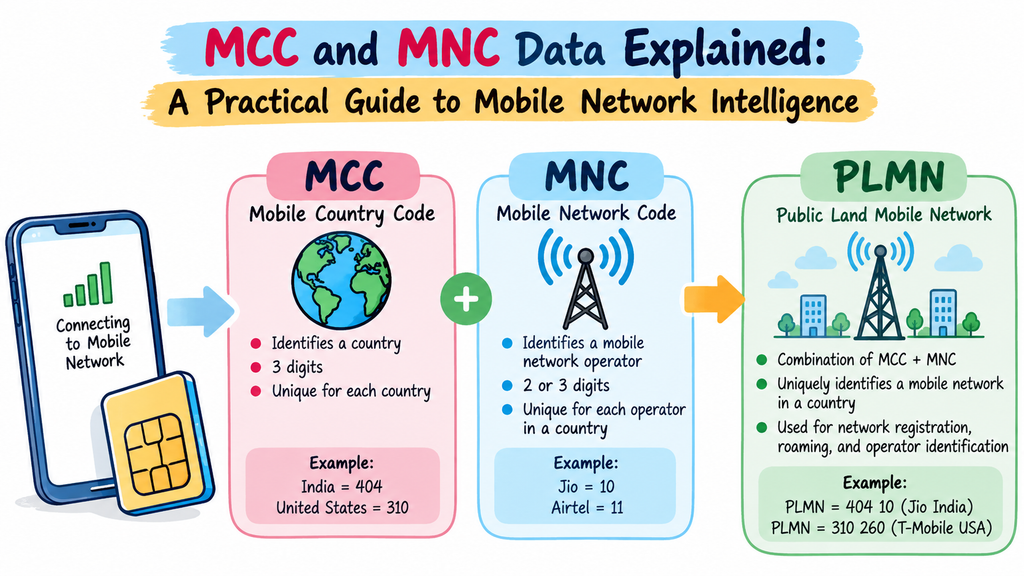
Three terms often appear in this work: MCC, MNC, and PLMN. Although they belong to the same identification framework, they serve different purposes.
An MCC provides the country-related component of a mobile network identity. An MNC distinguishes a network within the relevant MCC framework. A PLMN identity combines the two values to represent the identified network.
Understanding these terms is only the first step. The real challenge comes when people collect, compare, store, and interpret network data.
A database might contain an outdated operator name. A software system might remove a leading zero from a code. A directory might confuse a mobile service brand with the network that carries its traffic.
This guide explores how MCC and MNC data supports telecom research and digital products. It also explains practical ways to manage network records, reduce common data errors, and assess mobile network information.
Mobile Network Intelligence Starts With Structured Data
Mobile network intelligence involves collecting and analyzing information about cellular networks, operators, and related services.
The exact information depends on the project. A researcher may need a list of network operators in several countries. A developer may need to validate network identifiers. A connectivity business may want to organize information about its mobile network partners.
These tasks require consistent data.
Without a clear structure, different systems may store the same network information in different ways. One database might use an operator’s legal name. Another might use its consumer brand. A third might contain only a numeric identifier.
These differences make comparison harder.
MCC and MNC information provides a useful foundation for organizing mobile network identities. However, businesses should combine these identifiers with carefully verified supporting information when their projects require operator names, provider relationships, or geographic details.
What Makes Network Data Useful?
Useful network data should meet four basic requirements.
- Consistency: Every record should follow a defined structure.
- Accuracy: Identifiers should match reliable numbering information.
- Context: Records should explain what each value represents.
- Traceability: Users should be able to review the evidence behind important claims.
These qualities help businesses turn raw network records into information that people can understand and use.
Reading the Three Main Network Identifiers
Before working with telecom datasets, users need to understand the purpose of each identifier.
MCC: The Country-Related Component
MCC means Mobile Country Code.
It provides the country-related component of a mobile network identity within the applicable numbering system. Devices and telecom systems can use this information as part of network identification procedures.
For researchers, MCC values can help organize network records by the relevant country or geographic numbering area.
However, an MCC does not identify a specific operator by itself. Several mobile networks may share the same MCC.
MNC: The Network Identification Component
MNC means Mobile Network Code.
It distinguishes a mobile network within the relevant MCC framework. Researchers should therefore examine an MNC alongside its associated MCC instead of treating it as a complete identifier on its own.
MNC values may use two-digit or three-digit formats, depending on the numbering arrangement.
This difference matters when applications store and compare network codes. Developers should preserve the assigned format rather than allowing software to change it automatically.
PLMN: The Combined Network Identity
PLMN means Public Land Mobile Network.
In common mobile network identification, the PLMN identity combines MCC and MNC information. This combination represents the identified mobile network within the relevant numbering framework.
Technical teams may encounter PLMN identities in network documentation, configurations, and connectivity investigations.
A PLMN identity helps distinguish a network, but it does not describe every aspect of its business, coverage, technology, or service availability.
A Quick Reference Table
| Identifier | Main Function | Value for Data Projects | Important Limitation |
|---|---|---|---|
| MCC | Provides the country-related component | Helps organize network records by numbering area | Does not identify an individual operator alone |
| MNC | Distinguishes a network within the relevant MCC framework | Helps separate network records | Needs the correct MCC context |
| PLMN identity | Combines MCC and MNC | Represents the identified mobile network | Does not describe all network services or business relationships |
This distinction helps teams choose the right fields for their databases and applications.
How Businesses Use Mobile Network Data
Different industries use mobile network information for different reasons. The identifiers remain the same, but the business questions can vary.
Telecom Research and Market Analysis
Market researchers study operators, mobile services, and connectivity trends across regions.
A structured directory can help them organize operator records and compare information across markets. Researchers can use MCC and MNC values to distinguish network identities while maintaining separate fields for company names and commercial brands.
However, network identifiers alone cannot explain market share, customer numbers, pricing, or financial performance. Researchers need separate evidence for those questions.
Telecom Software Development
Software developers may work with mobile network information when building telecom-related tools.
A project might include a searchable operator directory, a network-code validation feature, or an internal dashboard for reviewing mobile network records.
Developers need consistent field definitions and reliable data. They should also account for different MNC lengths and preserve exact identifier formatting.
The right database design can prevent errors before they spread into reports or applications.
Connectivity Services
Connectivity providers may work with several mobile network partners across different countries.
Their internal teams may need structured records that connect network identities with verified provider information. Separate fields can help them distinguish the underlying network from the company that sells a service.
These records can support internal research and documentation. However, a network code does not independently confirm a provider’s current commercial agreement or service availability.
Travel Connectivity Research
Travel connectivity businesses may investigate mobile networks available in different destinations.
Network identifiers can help organize information about the networks associated with particular records. Researchers still need current information about coverage, roaming access, device compatibility, and product terms.
This distinction matters because identifying a mobile network does not guarantee that a particular SIM or eSIM can access it.
Turning Raw Network Codes Into Useful Records
A list of codes has limited value when users cannot connect each code to reliable context.
A well-designed dataset should make every record easy to interpret. It should also distinguish verified information from assumptions.
Consider a fictional dataset containing three network records.
| Record | MCC | MNC | Operator Name | Verification Status |
|---|---|---|---|---|
| Network Record A | Verified value | Verified value | Confirmed name | Verified |
| Network Record B | Verified value | Verified value | Unknown | Operator association needs review |
| Network Record C | Incomplete | Available value | Unconfirmed name | Incomplete |
This example uses descriptive labels rather than actual code assignments.
The first record contains a confirmed operator association. The second has valid code information but needs further evidence about the operator name. The third lacks enough information to support a complete identification.
A responsible directory should preserve these differences.
It should not invent an operator name simply because a code appears in a partial record. Instead, it should mark the missing information and provide a way to review it later.
Why This Approach Matters
Clear data status helps users understand what they can safely conclude.
A confirmed identifier and an unverified company name do not have the same level of reliability. Separating these fields prevents one verified detail from making an entire record appear confirmed.
This practice also makes future updates easier. Editors can correct the uncertain field without unnecessarily changing information that already has reliable support.
Designing a Database for MCC and MNC Records
Database structure affects the accuracy and usability of telecom information.
A poorly designed system can mix identifiers with company names or change code formats during import. A well-designed system keeps technical identity fields separate from descriptive information.
Recommended Data Fields
A mobile network database may include the following fields, depending on the project’s needs.
| Field Name | What It Stores | Why It Helps |
|---|---|---|
| MCC | Country-related code | Supports country-related grouping |
| MNC | Network code | Distinguishes networks within the relevant MCC framework |
| PLMN identity | Combined network identity | Provides a convenient network reference |
| Country or area | Associated geographic context | Helps users interpret the record |
| Operator name | Verified network operator | Connects the identity with an organization |
| Commercial brand | Consumer-facing brand, when relevant | Separates branding from network identity |
| Provider type | MNO, MVNO, eSIM provider, or another defined category | Clarifies the organization’s role |
| Source information | Evidence used to support the record | Helps reviewers check accuracy |
| Last checked | Date of the latest review | Supports data maintenance |
| Record status | Verified, incomplete, or unverified | Makes uncertainty visible |
Not every project needs every field. A simple lookup tool may need only a few fields, while a research directory may require a richer structure.
The important point is to define each field clearly and use it consistently.
Store Codes Without Changing Their Format
Developers should consider storing MCC and MNC values as text when the exact digit representation matters.
Some software systems automatically convert digit strings into numbers. This can remove leading zeros or change how a value appears.
For example, a code represented with a leading zero may lose that zero if a system treats it as an ordinary number.
That change can create problems during searches, comparisons, and exports.
Use validation rules that preserve the required format. Do not assume every MNC has the same length.
Keep Technical and Commercial Fields Separate
Avoid storing a network code, operator name, and commercial brand in one combined field.
Separate fields allow applications to search each type of information independently. They also make it easier to update a company name without changing the network identity.
When one company owns several brands, the database can represent those relationships without creating unsupported network assignments.
Data Quality Checks Every Telecom Directory Needs
A telecom directory can become unreliable when its owner collects records without checking them.
Data quality checks help identify missing values, inconsistent formats, and unsupported relationships.
Check the MCC-MNC Combination
A valid-looking MNC does not automatically identify the intended network.
Review the MCC and MNC together. Confirm that the combination matches reliable numbering information before linking it to a particular operator.
Validate Identifier Length and Formatting
Check that each stored value follows the expected format.
Preserve leading zeros where applicable. Avoid automatic conversions that change the original representation.
Review Operator Names
Company names can change, and different brands may use the same underlying network.
Check whether the operator name belongs to the relevant network record. Do not assume that a consumer-facing brand operates the network.
Flag Missing Information
Missing data should remain visibly incomplete.
Use labels such as “Not verified” or “Not publicly stated” when appropriate. These labels help readers distinguish unknown details from confirmed facts.
Record the Evidence
Maintain source information for important assignments and company relationships.
This makes it easier for another person to review the record and understand why the database contains a particular value.
Recheck Records When Evidence Changes
A directory should have a clear review process.
When a company announces a reorganization or changes its commercial brand, check whether the network record actually needs an update. Do not assume that every business change affects MCC or MNC assignments.
Understanding the Relationship Between Network Operators and Service Providers
Mobile network data often appears alongside information about several kinds of telecom businesses.
These organizations may cooperate, but their roles differ. A directory should explain those differences instead of placing every company in one category.
Mobile Network Operators
A mobile network operator manages mobile network infrastructure and provides cellular services according to its market arrangements.
Its technical network identity helps systems distinguish the relevant network.
Mobile Virtual Network Operators
An MVNO sells mobile services through arrangements involving another operator’s network infrastructure or wholesale access.
Some MVNOs may have assigned network identifiers. Others may rely on a host network’s identity in relevant situations.
The directory should verify the actual arrangement rather than applying one rule to every MVNO.
eSIM Service Providers
An eSIM provider may sell digital SIM profiles, travel data plans, or other mobile connectivity products.
The provider’s commercial name does not automatically reveal which mobile network supports a particular service in a particular location.
Researchers may need additional information about the profile, partner networks, roaming arrangements, and service terms.
Why Classification Matters
Incorrect classification can create false relationships in a database.
For example, a directory might list an eSIM brand as the operator of a network when the brand actually obtains connectivity through a partner.
Separate categories help users understand the roles each organization plays. They also help developers create more accurate search and filtering features.
MCC-MNC Lookup Tools: What to Expect
An MCC-MNC lookup tool helps users investigate mobile network identifiers through a searchable interface or database.
The amount of information varies by service. Some tools focus on code identification, while others include operator names, geographic context, or additional directory details.
Before using a lookup result in a business or technical project, consider its limitations.
Lookup Results Depend on the Underlying Data
A lookup tool cannot provide better information than its underlying records support.
If the database contains an outdated operator association, the lookup may display that association until someone corrects it.
Users should check available verification details and consult reliable reference information when accuracy matters.
Code Identification Does Not Confirm Service Availability
A lookup may identify a mobile network, but that does not prove that a particular device or SIM can connect to it.
Service availability can depend on device compatibility, network technology, coverage, subscription settings, roaming arrangements, and operator policies.
Use network-code information for identification. Use separate evidence to evaluate connectivity.
A Lookup Does Not Always Identify the Commercial Provider
The network associated with a code may differ from the company that sold a SIM or eSIM product.
A directory should not claim that a network operator and a commercial provider are the same organization without evidence.
API Access Requires Additional Checks
Some lookup services may offer an API, while others may not.
Developers should confirm availability through the provider’s actual documentation. They should also review field definitions, update frequency, access limits, usage terms, and error handling before building an integration.
An API should return information in a consistent format that matches the application’s requirements.
Common Mistakes in Mobile Network Research
Even experienced teams can make mistakes when they overlook the difference between identification data and descriptive information.
Using an MNC Without Its MCC
An MNC should not be treated as a globally unique network identifier by itself.
Always consider the associated MCC when identifying a network.
Assuming Similar Names Mean the Same Operator
Two companies may have similar names without sharing the same network identity.
Likewise, a single company may operate multiple brands. Verify the relationship before combining records.
Treating an eSIM Brand as a Network Operator
An eSIM provider may sell connectivity through other operators.
Identify the underlying network only when reliable information supports that conclusion.
Mixing Network Identity With Coverage Information
MCC and MNC codes identify networks. They do not provide a direct measure of coverage, speed, or service quality.
Use separate sources and measurements for performance questions.
Accepting Every Directory Record as Current
A record may contain old information or an incomplete operator association.
Check the source, verification status, and relevant documentation before using the record in a critical report.
Overlooking Data Formatting
Automatic number conversion can alter identifier values.
Use suitable storage formats and validation rules to preserve the original representation.
How to Choose a Telecom Data Directory
A useful directory should match the task you need to complete.
A developer may need structured fields and reliable search. A market researcher may need broader operator coverage. A telecom analyst may need detailed records and clear evidence.
Evaluate directories against the following criteria.
Coverage: Does the directory include the countries and numbering areas relevant to your work?
Field quality: Does it provide the identifiers and descriptive fields you need?
Verification: Can you understand how the directory supports its records?
Search options: Can you search by code, country, or operator name where appropriate?
Provider classification: Does the directory distinguish network operators, MVNOs, brands, and eSIM providers?
Data freshness: Does it explain when records were checked or updated?
Integration options: If you need programmatic access, does the provider document an API or data export?
Limitations: Does the directory clearly identify missing or uncertain information?
A directory does not need to provide every possible feature. It needs to provide suitable information with clear definitions and honest limitations.
The Future Value of Well-Organized Telecom Data
Telecom services continue to involve a broad range of operators, brands, and connectivity providers. Researchers and developers therefore benefit from consistent ways to organize network information.
Structured mobile network data can support several ongoing needs.
Easier Cross-Market Research
Consistent identifiers help researchers organize records from different countries and numbering areas.
Clear definitions also make it easier to compare records without confusing country-related codes with network-level identifiers.
More Reliable Software Integrations
Applications that depend on telecom records need predictable fields and consistent formats.
Good data practices reduce errors and help developers handle incomplete or unverified records more safely.
Clearer Provider Relationships
As businesses offer connectivity through different arrangements, directories need to distinguish network operators from commercial providers.
Separate fields and verified relationships help users understand who operates the network and who sells the service.
Better Transparency
A directory becomes more useful when it explains the source and status of its information.
Users can then judge whether a record suits their needs and identify details that require further checking.
The long-term value comes from reliable data management, not simply from collecting a large number of codes.
Frequently Asked Questions
1. What is the main purpose of MCC and MNC data?
MCC and MNC data helps identify mobile networks within a structured numbering system. The MCC provides the country-related component, while the MNC distinguishes a network within the relevant MCC framework.
2. Why do developers use mobile network code databases?
Developers may use these databases to search network records, validate identifiers, or support telecom-related applications. The appropriate fields depend on the application’s purpose and data requirements.
3. What does PLMN mean in a telecom database?
PLMN stands for Public Land Mobile Network. Its identity commonly combines MCC and MNC information to represent the identified mobile network.
4. Can a mobile network code identify a company’s commercial brand?
Not by itself. A network identifier represents a mobile network, while a commercial brand represents a product or service identity. Researchers need additional evidence to connect the two.
5. Why should MCC and MNC values use separate database fields?
Separate fields make records easier to search, validate, and maintain. They also help developers combine the values correctly when they need a PLMN identity.
6. What causes incorrect MCC-MNC lookup results?
Possible causes include outdated records, incorrect code formatting, incomplete operator associations, and weak data verification. Users should check the underlying information before relying on important results.
7. Do all eSIM providers operate their own mobile networks?
No. Some eSIM providers obtain connectivity through partner operators or other commercial arrangements. The provider’s role depends on its specific business model.
8. Can MCC-MNC data help troubleshoot connectivity problems?
It can help identify a network involved in an investigation. However, troubleshooting may also require device details, coverage information, subscription settings, roaming permissions, and network diagnostics.
9. How often should a telecom directory review its records?
The review schedule should reflect the directory’s purpose, available evidence, and the likelihood of changes. The owner should document checks and review records when credible information indicates that an update may be necessary.
10. What should I do when an operator association remains unconfirmed?
Keep the record clearly marked as unverified or incomplete. Do not guess the operator name. Seek reliable supporting information before presenting the association as confirmed.
Final Thoughts
Mobile network data becomes more valuable when people can interpret it correctly.
MCC and MNC provide structured components for identifying mobile networks, while PLMN combines those components into a network identity. These identifiers support telecom research, database design, software development, and network analysis.
However, accurate results require more than collecting code values. Teams need consistent formats, clear field definitions, reliable evidence, and regular data reviews.
They must also distinguish network operators from commercial brands, MVNOs, and eSIM providers. These organizations may work together, but their roles are not interchangeable.
A carefully maintained telecom directory helps users explore network information with greater confidence. By combining structured identifiers with verified context, businesses and developers can build more dependable telecom research workflows.
