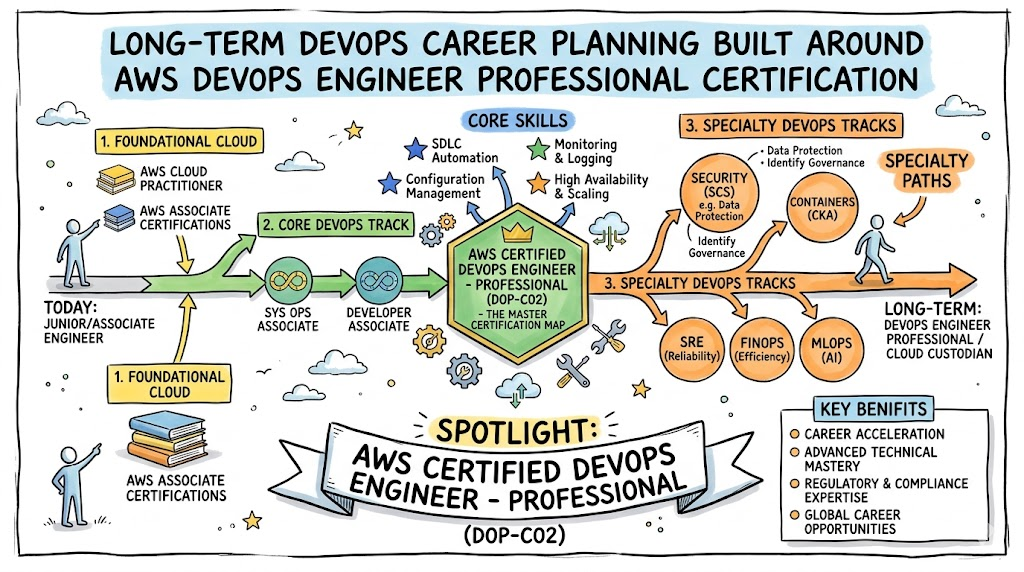
Introduction
The landscape of software development has undergone a tectonic shift. We have moved past the era of simply “making things work” in the cloud. We are now in the age of Digital Resilience. As a technical mentor who has navigated the transition from physical data centers to ephemeral serverless architectures, I have seen one truth remain constant: the most valuable engineers are those who can protect what they build.
For software engineers and engineering managers—whether you are operating in the high-growth hubs of India or leading global distributed teams—the definition of “Seniority” has been rewritten. It is no longer about how many lines of code you ship, but how much trust you can bake into the automation lifecycle. This guide explores the pinnacle of this expertise, focusing on the elite path of the AWS Certified Security – Specialty.
Brief Description for AWS Certified Security – Specialty
The AWS Certified Security – Specialty certification highlights professionals who specialise in protecting workloads on the AWS platform. It confirms that you can design secure architectures, define and enforce strong access controls, and keep sensitive information safe through effective encryption and careful key management. The exam also evaluates how you secure complex, multi‑account networks, organise meaningful logging and monitoring, and apply AWS security services to detect, analyse, and contain potential threats. Earning this credential shows that you are prepared to support business‑critical and compliance‑heavy applications on AWS with a mature, practical approach to cloud security.
Why Security Dictates Modern Cloud Success
In the modern ecosystem, security is not a “department”—it is a core feature of the product. With the rise of Infrastructure as Code (IaC) and automated pipelines, a single misconfigured script can expose millions of records in seconds. This has made the “Security-First” mindset the primary currency of the technical job market.
Automation is the Great Multiplier. If your security is manual, your automation is broken. High-performing organizations now prioritize DevSecOps, where security is integrated into every stage of the CI/CD pipeline. By mastering AWS security protocols, you aren’t just an administrator; you become an architect of digital trust. For a manager, having a team certified in these specialties is the ultimate risk mitigation strategy. It ensures that the speed of innovation never compromises the safety of the business.
Why Choose DevOpsSchool?
DevOpsSchool has established itself as the premier institution for technical mastery because they focus on the Practitioner’s Reality. They understand that an AWS certification is a milestone, but the ultimate goal is operational excellence.
The curriculum at DevOpsSchool is designed by experts who live in the trenches of production environments. They move beyond theory, focusing on hands-on labs that simulate real-world disasters, breaches, and configuration crises. By training with DevOpsSchool, you aren’t just learning to pass an exam; you are learning to lead a technical department with confidence.
AWS Certified Security – Specialty Overview
| Track | Level | Ideal For | Prerequisites | Skills Covered | Recommended Order |
| Security | Specialty | Security Leads, DevSecOps Engineers | 2+ Years AWS Exp | Encryption, IAM, Threat Detection | After Associate |
| DevOps | Professional | SREs, Automation Leads | Associate Knowledge | CI/CD, SDLC, HA, Monitoring | Final Step |
| Solutions Architect | Professional | Principal Engineers, Managers | Associate Knowledge | Complex Design, Migration | Final Step |
| Developer | Associate | Software Engineers | Basic Cloud Logic | SDKs, Serverless, Lambda | Step 2 |
| SysOps | Associate | Systems Admins, SREs | Basic IT Knowledge | Scaling, Health Monitoring | Step 2 |
Deep Dive: AWS Certified Security – Specialty (SCS-C02)
What it is
The AWS Certified Security – Specialty is an elite technical credential that validates your expertise in securing every layer of the AWS cloud. It is a comprehensive deep dive into identity management, data protection, and automated incident response at a global scale.
Who should take it
This is the “Black Belt” for Security Engineers, Senior DevOps Leads, and Cloud Architects. It is particularly essential for those working in sectors where data is the most sensitive asset, such as Fintech, E-commerce, and Healthcare.
Skills you’ll gain
- Identity Orchestration: Mastering complex IAM policies, Service Control Policies (SCPs), and cross-account access.
- Cryptographic Architecture: Implementing data-at-rest and data-in-transit encryption using KMS and CloudHSM.
- Network Defense: Hardening VPCs with WAF, Shield, and private endpoints to eliminate public attack surfaces.
- Threat Hunting: Using GuardDuty, Macie, and Security Hub to detect anomalies using machine learning.
- Automated Audit: Utilizing AWS Config and CloudTrail to maintain continuous, immutable compliance trails.
Real-world projects you should be able to do after it
- The Self-Healing Security Pipeline: Build a system that automatically revokes a developer’s permissions if they attempt to launch an unencrypted database.
- Zero-Trust Network Architecture: Design a multi-account environment where internal services communicate only via private, encrypted endpoints.
- Automated Forensic Vault: Create a workflow that automatically snapshots a compromised EC2 instance and moves it to an isolated account for investigation.
- Global Compliance Guardrails: Implement a company-wide policy using AWS Organizations that prevents any resource from being launched in insecure regions.
Mastery Preparation Plans
- 14 Days (The Expert Sprint): Only for those currently working as AWS Security Leads. Focus 100% on the “Security Pillars” whitepapers and intensive practice exams.
- 30 Days (The Standard Path): The recommended route for most engineers. 2 weeks on Labs (Identity, Cryptography, VPC), 1 week on monitoring tools, and 1 week on exam strategy.
- 60 Days (The Knowledge Deep-Dive): Recommended for developers or admins moving into security. Spend Month 1 mastering foundational AWS services. Spend Month 2 exclusively on the Specialty security domains.
Common Professional Mistakes
- Underestimating IAM Evaluation Logic: Many fail because they don’t understand that an “Explicit Deny” in a policy overrides everything else.
- Thinking Theory is Enough: The exam is scenario-based. If you haven’t “clicked the buttons” in a lab, you will likely struggle with the multi-answer questions.
- Ignoring the Shared Responsibility Model: Not knowing exactly what AWS protects versus what you are responsible for.
Strategic Next Steps
After achieving this milestone, you should broaden your horizon based on your career goals:
- Same-track option: AWS Certified Solutions Architect – Professional.
- Cross-track option: Certified Kubernetes Security Specialist (CKS).
- Leadership option: CISM (Certified Information Security Manager) to transition into Director-level roles.
Choose Your Path: 6 Specialized Career Tracks
Security is the thread that runs through every modern technical role. Choose the path that matches your ambition:
- The DevOps Path: Focus on the “Speed of Trust.” You ensure that the CI/CD pipeline is both fast and impenetrable.
- The DevSecOps Path: Focus on “Total Integration.” You build the automated security gates that code must pass through.
- The SRE Path: Focus on “Resilience.” You treat security failures as reliability issues, building self-healing systems.
- The AIOps/MLOps Path: Focus on “Intelligence.” You use machine learning to scan millions of logs and identify hidden threats.
- The DataOps Path: Focus on “Privacy.” You ensure that the flow of data is encrypted from ingestion to the data lake.
- The FinOps Path: Focus on “Efficiency.” You manage the financial impact of security, ensuring you aren’t overspending on unoptimized logging.
Role → Recommended Certifications Mapping
| If you are a… | Start with this… | Your target should be… |
| DevOps Engineer | AWS SysOps Associate | AWS DevOps Professional |
| SRE | AWS Developer Associate | AWS Security Specialty |
| Platform Engineer | Solutions Architect Assoc. | Certified Kubernetes Admin (CKA) |
| Cloud Engineer | Solutions Architect Assoc. | AWS Security Specialty |
| Security Engineer | AWS Security Specialty | AWS Solutions Architect Prof. |
| Data Engineer | AWS Data Engineer Assoc. | AWS Security Specialty |
| FinOps Practitioner | AWS Cloud Practitioner | AWS Solutions Architect Assoc. |
| Engineering Manager | AWS Cloud Practitioner | AWS Security Specialty |
Training Partners for Technical Certification
Mastering a Specialty level requires more than just self-study. These institutions provide the expert-led environment required to succeed:
- DevOpsSchool: A powerhouse in technical mentorship. They specialize in high-intensity, lab-focused training that bridges the gap between basic certification and professional expertise.
- Cotocus: Known for their deep-dive corporate technical consulting and tailored bootcamps for enterprise-level cloud security.
- Scmgalaxy: A massive repository of community-driven knowledge and technical guides, essential for troubleshooting and step-by-step tutorials.
- BestDevOps: Focuses on the vocational side of engineering, ensuring students can immediately apply their new skills to their current jobs.
- devsecopsschool.com: The primary destination for those focusing exclusively on the intersection of security and automation.
- sreschool.com: A dedicated institution for mastering site reliability engineering, focusing on building scalable and secure systems.
- aiopsschool.com: Leading the way in teaching how to use artificial intelligence to manage the next generation of cloud operations.
- dataopsschool.com: Focused on the unique security and operational needs of the data lifecycle.
- finopsschool.com: Training for the new generation of engineers who need to manage the economics and financial transparency of the cloud.
Career Growth & Certification FAQs (General)
1. Is the AWS Security Specialty a good first certification?
Generally, no. It is best to have an Associate-level understanding first. It assumes you already know how to build in the cloud; now you are learning to defend it.
2. Does a certification really help with salary hikes in India?
Absolutely. Specialized security professionals in India often command 30-50% higher salaries than generalist cloud engineers.
3. Can I get a remote job with an AWS Security certification?
Yes. Security is a global requirement. Many global companies hire Indian engineers to manage their cloud security remotely.
4. How much math do I need to know for encryption?
Very little. You don’t need to be a mathematician to use encryption tools like KMS. You just need to understand the logic of key policies.
5. How long does a certification stay on my resume?
It is valid for 3 years. After that, you recertify to show you are still current with the latest technology.
6. Is the exam multiple choice?
Yes, but the questions are “Scenario-based,” meaning you have to choose the best solution for a complex business problem.
7. Should I learn AWS or Azure first?
AWS currently has the largest market share globally. Learning it first usually provides the most job opportunities.
8. Do I need to be a coder to work in cloud security?
You don’t need to be a “Developer,” but you should be comfortable reading JSON and writing basic scripts to automate your work.
9. What is a “Service Control Policy” (SCP)?
Think of it as a “Master Rule” for an entire company. It can prevent anyone—even the admin—from doing something dangerous.
10. Will this help me move into management?
Yes. Modern managers need to understand risk. A security certification proves you understand how to protect the company’s assets.
11. Is the exam hard?
The Specialty exam is one of the more difficult ones, but with 30-60 days of focused study, it is very achievable.
12. Can I take the exam in my local language?
AWS offers exams in several languages, but taking it in English is the standard for the global tech market.
AWS Certified Security – Specialty (SCS-C02) Technical FAQs
1. What is the most important service for the SCS-C02?
IAM (Identity and Access Management). You must understand how to write complex policies and troubleshoot permission issues.
2. How much of the exam is about networking?
About 20%. You need to know about VPC Peering, VPC Endpoints, and how to use Security Groups vs. NACLs.
3. What is the difference between AWS GuardDuty and AWS Inspector?
GuardDuty is for monitoring suspicious behavior (like an intruder). Inspector is for scanning your own code for weaknesses.
4. Do I need to know about “On-Premise” security?
Yes. You must know how to securely connect an office to AWS using a VPN or Direct Connect.
5. How does AWS WAF protect my app?
It acts as a filter for your website, blocking common attacks like SQL injection and cross-site scripting (XSS).
6. What is “Envelope Encryption”?
It is a method where you use a “Master Key” to encrypt a “Data Key,” which then encrypts the actual data.
7. How do I track “Who did what” in AWS?
You use AWS CloudTrail. It is the digital diary of every action taken in your AWS account.
8. What is a VPC Endpoint?
It allows you to connect your private resources to other AWS services without ever sending that data over the public internet.
Conclusion
In the professional landscape, the gap between “knowing” and “leading” is defined by your ability to secure the future. The AWS Certified Security – Specialty is more than just a badge; it is a declaration of your commitment to technical excellence and digital trust.
Whether you are looking to secure a salary hike, move into a leadership role, or simply build more resilient systems, the path forward is clear. Lean on the mentorship of experts and the resources at DevOpsSchool, build your hands-on experience, and take the first step toward becoming the guardian of the cloud frontier.
